Nearcast
Peer-to-Peer Video Chat Platform
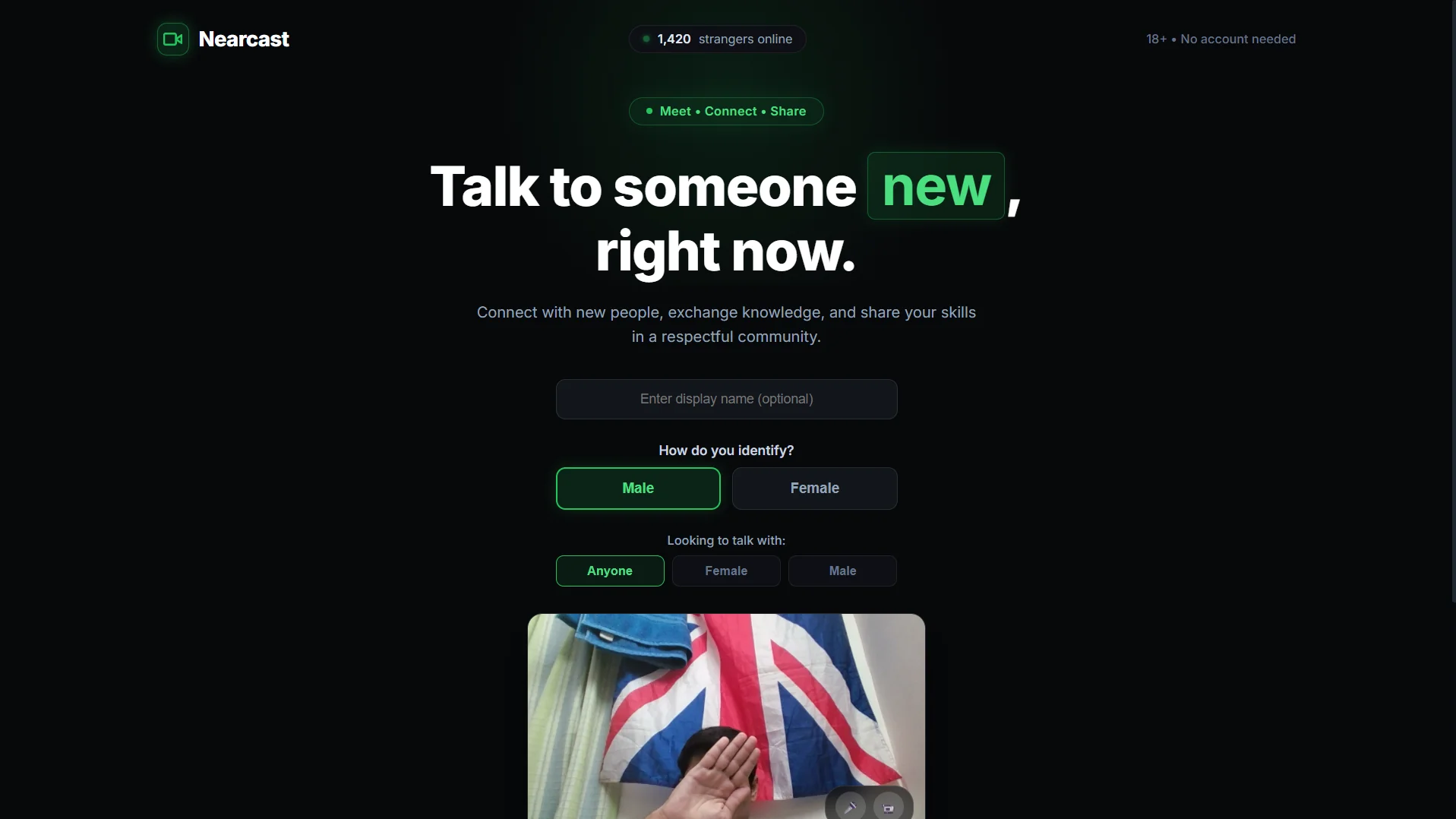
Overview
A real-time peer-to-peer video and text chat application that connects strangers for live conversation using WebRTC, Socket.IO, React, and Express with hybrid architecture keeping signaling centralized while streaming media directly between browsers.
Nearcast is a peer-to-peer video chat platform that connects random strangers for live conversation. Built with WebRTC for direct browser-to-browser media streaming and Socket.IO for signaling, it demonstrates a hybrid architecture where the server only facilitates connection setup while media flows peer-to-peer.
Key Features
Peer-to-Peer Media
WebRTC direct browser-to-browser video and audio streaming with Google STUN server for NAT traversal
Real-Time Text Chat
Integrated instant messaging with timestamps, auto-scroll, and disconnect notifications
Preference Matching
Connect with strangers based on stated identity preferences (Male/Female/Any)
In-Call Controls
Mute/unmute, camera toggle, screen sharing, report user modal, and 'Next Stranger' skip
Privacy by Design
P2P streams never stored on server, no accounts required, end-to-end encrypted media
Modern Dark UI
Custom visual identity with dark theme (#07080a), green accents (#22c55e), translucent badges
Technology Stack
Challenges
Implementing reliable WebRTC peer-to-peer connections with NAT traversal
Building a matching queue system with preference-based pairing
Managing Socket.IO signaling for offers, answers, and ICE candidates
Handling graceful disconnects, reconnects, and 'Next Stranger' functionality
Ensuring privacy by keeping media streams peer-to-peer without server storage
Solutions
Built UserManager for queue management with preference-based matching (Male/Female/Any)
Designed RoomManager for 1-to-1 WebRTC signaling relay via Socket.IO events
Implemented Google STUN server for NAT traversal and ICE candidate exchange
Created React components with getUserMedia for camera/mic access and RTCPeerConnection management
Added in-call controls: mute, camera toggle, screen share, and skip to next stranger
Built integrated text chat with timestamps and auto-scroll alongside video streams
Project Architecture
// Project Structure
nearcast/
├── backend/
│   ├── src/
│   │   ├── index.ts         # Express + Socket.IO
│   │   └── managers/
│   │       ├── UserManager.ts # Queue & matching
│   │       └── RoomManager.ts # WebRTC signaling
│   ├── package.json
│   └── tsconfig.json
├── frontend/
│   ├── src/
│   │   ├── components/
│   │   │   ├── Landing.tsx  # Landing with preview
│   │   │   └── Room.tsx     # Video grid + chat
│   │   ├── App.tsx
│   │   └── index.css
│   ├── vite.config.ts
│   └── package.json
├── Dockerfile
└── vercel.json
Key Learnings
WebRTC architecture: RTCPeerConnection, SDP offers/answers, ICE candidate exchange
Socket.IO real-time bidirectional communication patterns for signaling
NAT traversal strategies with STUN servers and when TURN servers are needed
getUserMedia API for camera/microphone access with permission handling
Peer connection lifecycle management: setup, negotiation, connection states, cleanup
Building hybrid architectures: centralized signaling with peer-to-peer media
Privacy-first design: no server-side media storage, minimal metadata collection
Future Enhancements
TURN server integration for restrictive NAT, horizontal scaling with Redis for shared state, content moderation system, session timeouts, and CDN delivery for static assets.