Pluto
Multi-Agent AI Workspace
Overview
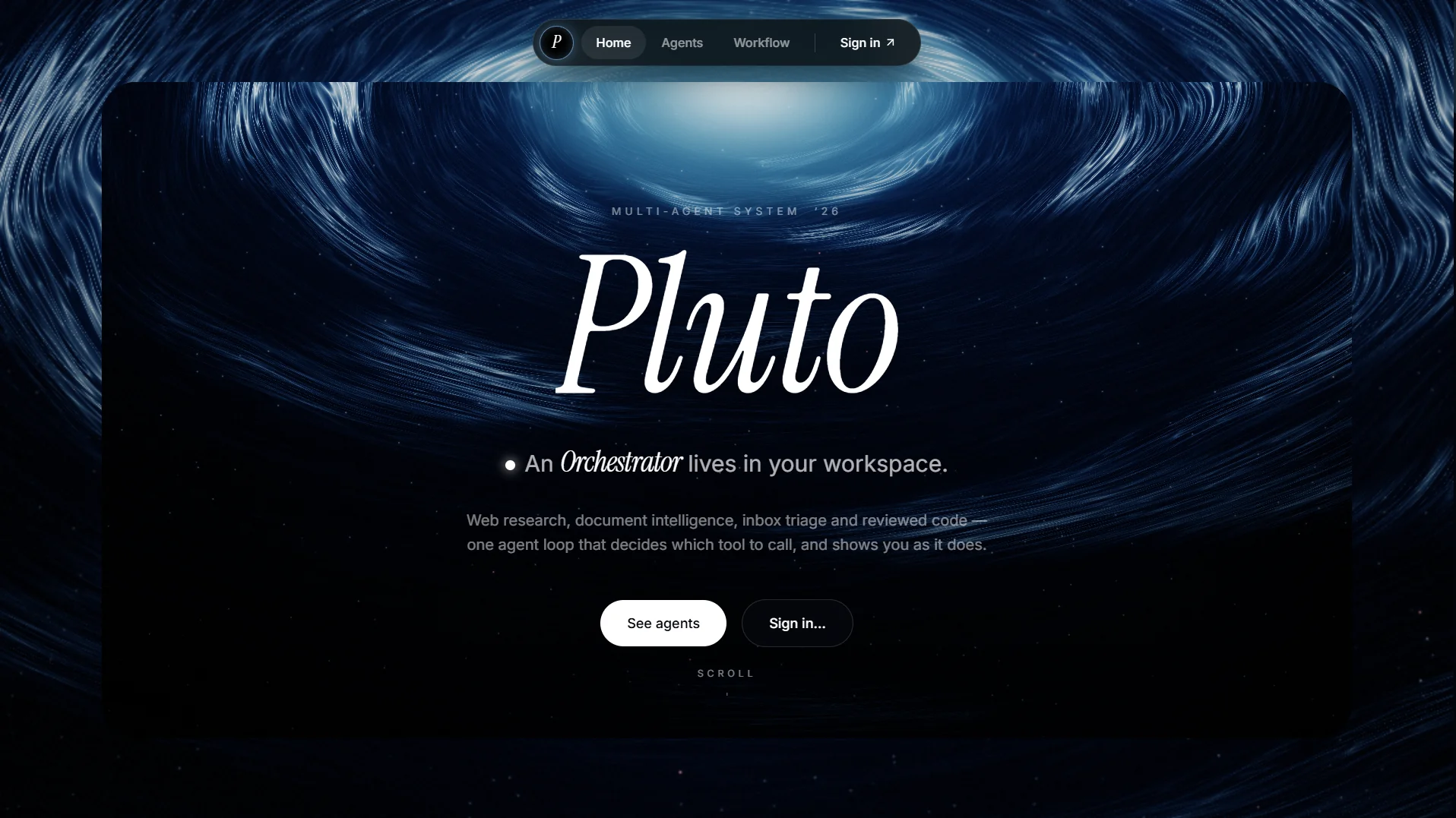
A production-ready multi-agent AI workspace built on LangGraph that orchestrates web search, document intelligence, Gmail triage, and code generation with streaming responses and dynamic agent routing based on context.
Pluto is a production-grade multi-agent AI workspace that unifies web research, document intelligence, Gmail integration, and code generation. Built on LangGraph with streaming responses, it dynamically routes queries to specialized agents while maintaining per-user isolation and comprehensive security controls.
Key Features
Streaming Agent Chat
Real-time token streaming over Server-Sent Events with live topology map showing agent and tool invocations
Multi-Agent System
Orchestrator routes to specialized agents: Web Research, RAG, Gmail, Code Generator, and Code Critic
Universal LLM Support
Google Gemini, OpenAI, Anthropic Claude, Groq, OpenRouter, and local Ollama models
Per-User Isolation
Conversations, documents, Gmail data, and long-term memory scoped to authenticated user
Security First
Google Sign-In, JWT auth, PBKDF2 hashing, encrypted OAuth tokens, CSRF protection, rate limiting
Observability
Structured JSON logging, Prometheus metrics, liveness/readiness probes, audit trail
Technology Stack
Challenges
Building a stateful agent orchestration system with deliberate routing and streaming responses
Implementing per-user isolation across conversations, documents, and Gmail data
Integrating multiple LLM providers (Google, OpenAI, Anthropic, Groq, OpenRouter, Ollama) with unified interface
Ensuring security with encrypted OAuth tokens, JWT authentication, and CSRF protection
Managing real-time streaming responses with live topology visualization
Solutions
Built LangGraph orchestrator with context-aware agent selection and tool invocation
Designed user-scoped data layer with PostgreSQL for structured data, Redis for ephemeral state, ChromaDB for vectors
Created provider-agnostic LLM factory with automatic provider detection from available API keys
Implemented comprehensive security: PBKDF2 password hashing (600k iterations), Fernet token encryption, JWT signing, rate limiting
Built SSE streaming pipeline with token-level events, tool execution tracking, and error handling
Added Prometheus metrics, structured logging with request IDs, and health probes for Kubernetes
Project Architecture
// Project Structure
pluto/
├── agents/                  # Multi-agent system
│   ├── orchestrator.py      # LangGraph orchestrator
│   ├── research_agent.py    # Web search agent
│   ├── rag_agent.py         # Document retrieval
│   ├── gmail_agent.py       # Email triage
│   ├── code_generator.py    # Code generation
│   └── code_critic.py       # Code review
├── api/v1/                  # FastAPI HTTP layer
│   ├── auth.py
│   ├── chat.py
│   ├── code.py
│   ├── gmail.py
│   └── rag.py
├── core/                    # Cross-cutting concerns
│   ├── config.py
│   ├── logging.py
│   ├── security.py
│   ├── rate_limit.py
│   └── metrics.py
├── llm_provider/            # LLM abstraction
├── memory/                  # PostgreSQL + Redis
├── rag/                     # Document processing
├── tools/                   # LangChain tools
└── frontend/                # React SPA
Key Learnings
LangGraph agent orchestration and stateful workflow design
Multi-provider LLM integration patterns and model-specific parameter handling
Server-Sent Events (SSE) for real-time streaming with backpressure handling
Per-user data isolation at query, memory, and tool levels
Production security patterns: JWT lifecycle, OAuth token encryption, password hash upgrades
FastAPI application architecture with dependency injection and middleware composition
Observability best practices: structured logging, distributed tracing, Prometheus metrics
Future Enhancements
Real-time streaming via WebSocket, advanced time-series models, multi-tenant authentication, Kubernetes deployment, automated scaling, and interactive scenario planning with enhanced agent collaboration.